
Imagine you are waiting for approval before sending an important email, starting a project, entering a meeting room, or moving to the next step of a process. Your manager replies, Please continue In just two words, you now know that you have permission to continue.
Please continue is a concise way to give permission, direction, or approval to continue with an action or process. It appears frequently in professional emails, meetings, instructions, customer service, business communication, and formal conversations. Although the phrase is clear and useful, choosing an alternative can sometimes make a message sound warmer, more conversational, more encouraging, or more specific.
The best wording depends on your relationship with the reader, the seriousness of the situation, and what you want the other person to do. A manager might say Please continue as discussed,” while a colleague may simply write “Go ahead.” Understanding these differences helps professionals, students, ESL learners, and content writers communicate with greater precision.
What Does Please continue Mean?
Please continue means that someone is being politely instructed or given permission to continue with an action, task, discussion, or process. It is commonly used when a person has been waiting for approval or direction, such as in workplace emails, meetings, formal instructions, customer service interactions, applications, and business procedures.
Origin & History of Please Proceed
The expression combines two ordinary English elements: “please,” a politeness marker used to make requests or instructions less abrupt, and “proceed,” a verb derived from Latin procedere, meaning “to go forward” or “advance.”
The verb proceed entered English through Anglo-French and Old French influences after the Norman period. Over time, it developed the familiar sense of moving forward, continuing, or carrying out the next stage of something.
“Please” also has a long history in English. It developed from expressions associated with giving pleasure or satisfaction and gradually became an established way to soften requests and commands.
The combined expression Please continue fits naturally into formal English because it separates permission from the action itself. Rather than saying “Do it,” the speaker uses “please” to add politeness and “proceed” to identify continuation.
Its modern popularity is closely connected with business, administration, customer service, legal correspondence, education, and institutional communication, where people often need concise language for granting permission or directing the next step.
Today, the phrase can sound professional and efficient, although in everyday conversation it may feel more formal than necessary.
Synonyms & Alternatives by Tone
Professional & Neutral Alternatives
- Please continue
- You may proceed
- Proceed as planned
- Please move forward
- You can move ahead
- Continue with the process
- Proceed with the next step
- Please carry on
- You have my approval
Polite & Supportive Alternatives
- Feel free to continue
- You may continue when ready
- Please go ahead
- You can continue from here
- Please move forward with it
- You can take the next step
Encouraging & Reassuring Alternatives
- Go ahead
- Keep going
- You’re good to go
- Feel free to move ahead
- Let’s move forward
- You can go ahead with it
Casual, Playful & Idiomatic Alternatives
- Go for it
- Go ahead
- Carry on
- Keep going
- You’re good to go
- Have at it
When Should You Use Please continue ?
Please continue works best when someone needs clear permission or direction to continue. It is particularly useful when the next action is already understood.
Professional settings
The phrase works naturally in workplaces, business correspondence, customer support, project management, administration, and formal instructions.
For example:
“The budget has been approved. Please continue with the purchase.”
This tells the recipient that approval has been granted and the next action can begin.
Casual conversations
It can be used in casual conversation, but it may sound more formal than alternatives such as “go ahead” or “carry on.”
A friend is more likely to say:
“Go ahead and tell me.”
rather than:
Please continue with your story.”
The second version is grammatically correct but intentionally formal or humorous.
Writing, presentations, and digital communication
Please continue is useful in emails, reports, instructions, project updates, forms, and professional messaging.
It can also work during presentations:
“If there are no further questions, Please continue to the next section.”
When it is especially effective
Use it when:
- Permission has already been discussed.
- The next action is clear.
- You want to be concise.
- A professional tone is appropriate.
- The recipient needs confirmation before continuing.
The phrase is strongest when clarity matters more than warmth.
When Should You Avoid “Please Proceed”?
Although Please continue is correct, it is not ideal for every situation.
Overly formal situations
In friendly conversations, the expression can sound stiff. “Go ahead” or “Sure, continue” may feel more natural.
Legal, academic, or sensitive contexts
In highly sensitive communication, Please continue can be too vague if the recipient needs exact instructions.
For example, instead of:
Please continue with the matter.”
a legal or compliance message may need to specify exactly which action is authorized, by whom, and under what conditions.
Situations where nuance may be lost
Please continue does not always communicate whether the speaker is enthusiastic, reluctant, cautious, or simply granting permission.
If encouragement matters, consider:
“Feel free to move forward.”
If urgency matters, a more specific instruction may be better:
Please continue with the submission today.”
If collaboration matters:
“Let’s move forward together.”
Is Please continue Professional, Polite, or Casual?
Please continue is primarily professional and formal-neutral. It is polite because “please” softens the instruction, but the phrase remains direct because “proceed” clearly signals continuation.
Tone analysis
- Formality: Medium to high
- Politeness: High
- Directness: High
- Warmth: Low to medium
- Casualness: Low
- Authority: Medium to high
- Emotional expression: Low
The phrase generally sounds controlled and businesslike. It does not necessarily express enthusiasm or personal warmth.
A manager writing Please continue with the proposal” is granting permission.
A colleague writing “Go ahead with the proposal” may sound more relaxed.
A teammate writing “Let’s move forward with the proposal” emphasizes collaboration.
Audience perception
Native speakers generally understand Please continue immediately, but their interpretation can depend on context. In a formal email, it may sound appropriately professional. In a text message between close friends, it can sound unusually stiff or even joking.
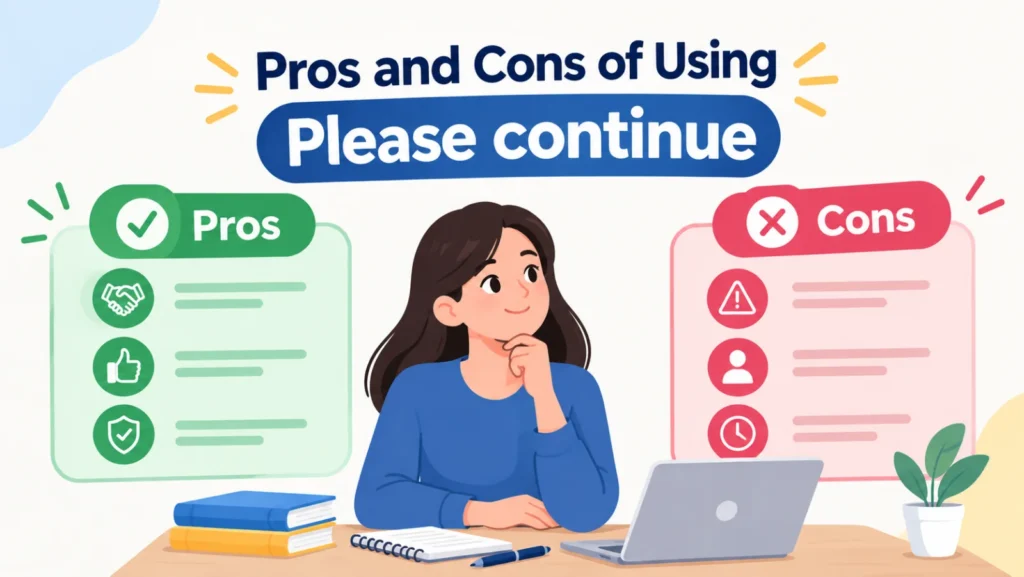
Pros and Cons of Using Please continue
Advantages
- Clarity: The recipient understands that continuation is allowed or expected.
- Efficiency: Two words can communicate permission without unnecessary explanation.
- Accessibility: The expression is widely understood by English speakers.
- Professionalism: It fits business and administrative communication.
- Neutrality: It does not usually introduce strong emotion.
- Directness: It reduces uncertainty about whether someone should continue.
Potential Drawbacks
- Oversimplification: It may not explain exactly what should happen next.
- Tone mismatch: It can sound too formal in casual communication.
- Repetition: Frequent use can make workplace messages feel mechanical.
- Limited warmth: It does not strongly communicate encouragement or collaboration.
- Possible ambiguity: “Proceed” can leave the specific next action unstated.
Real-Life Examples of Please continue by Context
Emails
“Thanks for confirming the final specifications. Everything looks correct on our end, so Please continue with production.”
This is appropriate when a recipient is waiting for confirmation.
Meetings
“We have covered the main concerns, so Please continue with the implementation timeline.”
Here, the phrase signals that the discussion can move to the next stage.
Presentations
“The background information is now complete. Please continue to the results section.”
This gives a clear transition.
Conversations
“If you have something you want to add, Please continue .”
This is understandable but somewhat formal. “Go ahead” would usually sound more natural in everyday conversation.
Social media
A formal version might appear in a professional community:
“The guidelines are available above. If everything is clear, Please continue with your submission.”
For ordinary social media, however, “go ahead” is generally more conversational.
Please continue vs Similar Expressions (Key Differences)
| Phrase | Meaning Difference | Tone Difference | Best Use Scenario |
| Please continue | Tells someone to keep doing what they are already doing | Professional, neutral | Meetings, presentations, conversations |
| Go ahead | Gives permission to start or continue | Casual, friendly | Everyday conversation and workplace chat |
| You may proceed | Explicitly grants permission | Formal, authoritative | Official or professional communication |
| Please move forward | Encourages advancement to the next stage | Professional, collaborative | Projects and decisions |
| Carry on | Tells someone to continue | Casual, sometimes British-sounding | Informal conversation |
| Feel free to continue | Gives permission while reducing pressure | Warm, supportive | Colleagues, customers, friendly communication |
Meaning differences
The key distinction is that “proceed” focuses on moving forward, while “continue” emphasizes maintaining an existing activity.
Tone differences
Please continue is more formal than “go ahead.” “Feel free to continue” is warmer, while “you may proceed” sounds more authoritative.
Best-use scenarios
Choose the expression according to the relationship and purpose. Use formal language when documenting approval, conversational language when speaking with colleagues, and supportive language when you want the recipient to feel comfortable.
Common Mistakes & Misuse of Please continue
Overuse
Using “Please continue ” repeatedly in every email can make communication sound automated.
Instead of writing:
“Please continue with the report. Please continue with the upload. Please continue with the review.”
combine the instructions:
“Please complete the report, upload the final version, and begin the review.”
Incorrect context
Do not use “proceed” when you actually mean start from scratch unless the context clearly establishes the next step.
For example, Please continue is more natural when someone has already received instructions or approval.
Contradictory usage
Avoid pairing the phrase with language that simultaneously tells someone not to continue.
Incorrect:
“Please continue, but do not take any action yet.”
The recipient cannot reasonably know what action is authorized.
Cultural misunderstandings
English learners may assume Please continue sounds polite in every situation. It is polite, but politeness and naturalness are not always the same thing.
In relaxed conversation, “go ahead” may communicate the same permission more naturally.
Psychological Reason People Prefer Please continue
Cognitive load reduction
Short expressions reduce the amount of language a reader must process. When the context is already established, Please continue can communicate the decision without repeating the entire instruction.
Trust and authority signals
In professional settings, concise permission can signal that the speaker has made or communicated a decision. This is especially useful when a person is waiting for authorization.
Attention economy
Modern professionals often scan emails and messages quickly. A short phrase such as Please continue can make the intended action easy to identify.
Modern communication habits
Digital communication has encouraged shorter workplace messages. People increasingly expect messages to communicate what happened, what was decided, and what happens next without unnecessary wording.
Still, brevity should not replace necessary detail. If the next step is unclear, a longer but more specific sentence is better.
US vs UK Usage of Please Proceed
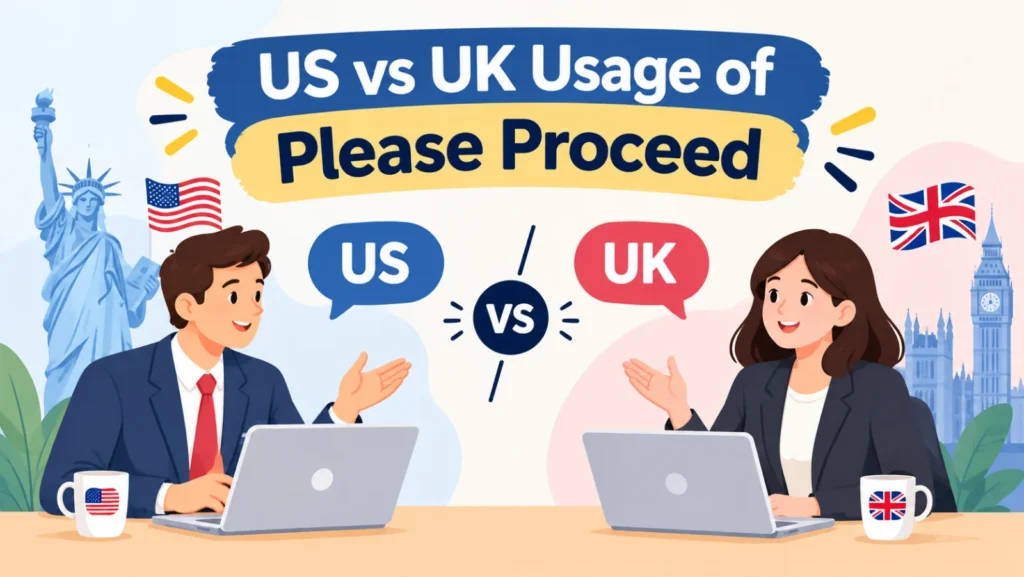
Please continue is understood and used in both American and British English. There is no major difference in its basic meaning.
Popularity
The phrase appears naturally in professional, administrative, and formal communication in both varieties of English.
Tone perception
American English speakers may sometimes perceive Please continue as especially formal or institutional in ordinary conversation.
British English speakers also use it formally, while expressions such as “carry on” can be more familiar in casual British conversation.
Regional preferences
The important difference is usually context rather than grammar. “Go ahead” is widely natural in both countries, while “carry on” may have a stronger informal British association.
For international communication, Please continue is generally safe because its meaning is straightforward.
Please continue in Digital & Modern Communication
Emails
Please continue remains common in workplace email because it communicates approval efficiently.
“The client has approved the revised version. Please continue with the final upload.”
Slack / WhatsApp
In Slack or WhatsApp, the phrase may sound more formal depending on the relationship.
A team member might naturally write:
“Yep, looks good. Go ahead.”
rather than:
Please continue .
Social media
The phrase is more common in professional posts, formal communities, instructions, and customer-service communication than in casual social conversations.
AI-generated summaries
AI-generated workplace summaries often favor concise expressions such as Please continue “continue,” and “move forward” because they clearly identify an action or decision.
However, human editors should check the tone. An efficient phrase is not automatically the most natural phrase.
Linguistic & Communication Insight
Emotional weight & subtext
The literal meaning of Please continue is straightforward: continue or move forward. Its emotional subtext is usually limited.
That neutrality is useful, but it also means the phrase does not strongly communicate enthusiasm.
Compare:
Please continue with the plan.”
with:
“I’m happy with the plan go ahead.”
The first communicates authorization. The second communicates authorization plus positive feeling.
Direct vs indirect phrasing
Please continue is relatively direct. It tells the recipient that continuation is acceptable without spending many words explaining the speaker’s reasoning.
Softer alternatives can reduce the force:
“Feel free to continue.”
More collaborative language changes the relationship:
“Let’s move forward.”
More authoritative wording strengthens permission:
“You may proceed.”
The difference is not simply vocabulary. Each choice positions the speaker differently in relation to the listener.
Professional communication perspective
In workplace communication,Please continue can be valuable when a person is waiting for confirmation.
For example:
“The revised contract has been reviewed and approved. Please continue with the next stage.”
This is clear because the surrounding sentence establishes what approval means.
The phrase becomes less effective when used without enough context:
Please continue.
Proceed with what?
In such cases, specificity improves communication.
Pragmatic reasons for alternatives
Experienced communicators often choose alternatives based on the reaction they want to create.
A manager may choose “go ahead” to sound approachable.
A project lead may choose “let’s move forward” to emphasize teamwork.
A customer-service representative may choose “feel free to continue” to sound reassuring.
A formal institution may choose “you may proceed” to communicate authorization clearly.
Social signaling
Word choice signals more than information. It can communicate distance, authority, friendliness, confidence, or collaboration.
Please continue creates professional distance.
“Go ahead” reduces that distance.
“Let’s move forward” creates a sense of shared responsibility.
“Feel free to continue” places more emphasis on the recipient’s comfort.
Tone & context guidance
Use Please continue when you want clear, professional permission. Consider another expression when warmth, enthusiasm, collaboration, or informality is more important.
A useful rule is:
If the recipient needs authorization, Please continue works well. If the recipient needs encouragement, choose a warmer alternative.
Meaning, Usage & Examples for Each Alternative
Please Continue
Meaning: “Please continue” tells someone to keep doing something that is already underway or to resume an activity.
Why This Phrase Works: It is clear, polite, and slightly more conversational than “Please continue .”
Real-World Usage Insight: This phrase is especially natural when someone is speaking, presenting, writing, or explaining something and another person wants them to keep going.
Best Use: Meetings, presentations, conversations, interviews, and professional messages.
Avoid When: You are specifically granting formal authorization for a new stage of a process.
Tone: Polite, neutral, professional, and approachable.
US vs UK Usage: Common and natural in both American and British English.
Example (Meeting): “Sorry for interrupting. Please continue with the budget explanation.”
Go Ahead
Meaning: “Go ahead” gives someone permission to start or continue an action.
Why This Phrase Works: It is one of the most natural everyday alternatives to “Please continue .”
Real-World Usage Insight: Native speakers use “go ahead” constantly in conversation, workplace chat, and informal emails because it sounds direct without being stiff.
Best Use: Everyday conversations, Slack messages, workplace discussions, and friendly emails.
Avoid When: Writing highly formal instructions where explicit authorization needs to sound official.
Tone: Casual, friendly, direct, and reassuring.
US vs UK Usage: Very common in both American and British English.
Example (Email): “The revised mockup looks good to me. Go ahead and send it to the client.”
You May Proceed
Meaning: “You may proceed” formally tells someone that they have permission to continue.
Why This Phrase Works: It clearly communicates authorization and leaves little doubt about whether action is permitted.
Real-World Usage Insight: This wording is particularly useful when the speaker represents an organization, authority, or formal decision-making process.
Best Use: Formal emails, official instructions, administrative communication, and permission-based situations.
Avoid When: Speaking casually with friends or close colleagues.
Tone: Formal, authoritative, controlled, and polite.
US vs UK Usage: Used in both varieties, particularly in formal contexts.
Example (Email): “Your application has passed the initial review. You may proceed to the final submission.”
Conclusion
Please continue is a concise, professional expression used to give permission, direction, or approval to continue with an action or process. Its straightforward meaning makes it useful in emails, meetings, business communication, customer service, presentations, and other situations where clarity matters. However, choosing the right alternative depends on the audience, relationship, and intended tone. “Go ahead” sounds more natural and conversational, while “you may proceed” provides a more formal sense of authorization. Similarly, “please continue” emphasizes an ongoing activity, whereas “let’s move forward” highlights collaboration.
Understanding these subtle differences helps writers and speakers avoid language that feels too formal, vague, or impersonal. For professionals, students, ESL learners, and content writers, knowing when to use “Please continue and when to replace it can make communication more precise and effective. Ultimately, the best wording is the one that clearly communicates the intended action while matching the situation and audience.
FAQs
What does please proceed mean?
Please continue means please continue, move forward, or take the next authorized action. It is commonly used when someone is waiting for permission, confirmation, or instructions. The phrase frequently appears in professional emails, meetings, business communication, customer service, presentations, and administrative situations. Its meaning is generally clear, polite, direct, and professional.
Is Please continue professional?
Yes,Please continue is a professional expression. It works particularly well in workplace emails, project management, business correspondence, meetings, and formal instructions. The phrase communicates permission or direction without unnecessary wording. However, in informal conversations or friendly messages, “go ahead” may sound more natural and approachable.
Is Please continue polite?
Yes. The word “please” makes the instruction polite, while “proceed” communicates the requested action clearly. However, politeness does not always mean informality. Please continue can sound somewhat formal or distant in casual situations, so alternatives such as “go ahead” or “feel free to continue” may be better for friendly communication.
What is another way to say please proceed ?
Common alternatives include “please continue,” “go ahead,” “you may proceed,” “please move forward,” “proceed as planned,” “feel free to continue,” and “let’s move forward.” The best choice depends on the intended tone. “Go ahead” is casual, “you may proceed” is formal, and “let’s move forward” emphasizes collaboration.
What is the difference between please continue and “go ahead”?
Both expressions can give permission to continue, but their tone differs. Please continue sounds more formal and professional, while “go ahead” is more conversational and relaxed. For example, a manager might write Please continue with the final report” in a formal email, while “Go ahead with it” is more natural in workplace chat.
Can I use Please continue in an email?
Yes. Please continue is appropriate for professional emails when someone is waiting for approval or direction. For greater clarity, identify the action that should follow. For example, “The proposal has been approved. Please continue with the final submission.” This makes the instruction more useful than simply writing “Please continue.”
Is Please continue formal or casual?
Please continue is generally formal or professional-neutral rather than casual. It is suitable for business emails, official communication, meetings, and administrative instructions. In casual conversations, “go ahead,” “carry on,” or “keep going” usually sounds more natural. The phrase is not excessively formal, but it can feel stiff in relaxed social situations.
What is the difference between Please continue and “please continue”?
Please continue generally refers to moving forward with an action, process, or next stage, while “please continue” usually means keeping an existing activity going. For example, “Please continue with the application” refers to the next stage, whereas “Please continue explaining the problem” asks someone to keep doing what they are already doing.
Does please proceed sound rude?
No. Please continue is normally polite and professional, not rude. However, its formal wording can sometimes sound distant or impersonal, particularly in casual conversations. If you want a warmer tone, “go ahead,” “feel free to continue,” or “you can move ahead” may be more appropriate.
What is the best alternative to Please continue?
The best alternative depends on context. “Go ahead” is usually the best casual option, “please continue” works well for ongoing activities, “you may proceed” suits formal authorization, and “let’s move forward” is useful when emphasizing teamwork. Choosing according to tone and purpose produces more natural and effective communication.