
Imagine your team has finally reached the final stage of a major project. Everything is going smoothly, the client seems impressed, and someone says, “This is definitely going to be our biggest success yet.” Another coworker laughs and replies, Don’t tempt fate. Everyone understands what they mean: enjoy the positive moment, but do not speak too confidently about the outcome in case something goes wrong.
Don’t tempt fate” is a common informal expression used when someone believes that talking too confidently about a positive situation might cause it to fail or change. The phrase is often used humorously, but it can also communicate caution, modesty, or a desire not to celebrate before something is certain.
Understanding alternatives to Don’t tempt fate is useful because the original expression is strongly conversational. A friend may naturally say it during a casual conversation, while a professional email may call for something more neutral, such as “Let’s not get ahead of ourselves” or “Let’s wait until everything is confirmed.”
Choosing the right alternative depends on your relationship with the audience, the situation, and the message you want to communicate. The best wording can preserve the idea of caution without sounding superstitious, overly negative, or unnecessarily informal.
What Does “Don’t Jinx It” Mean?
Don’t tempt fate means do not talk or act too confidently about a favorable situation because doing so is believed to risk causing an unwanted change or failure. The expression is commonly used in casual conversations, sports, work discussions, celebrations, and situations where an outcome is positive but not yet certain.
Origin & History of Don’t tempt fate
The word jinx has a long and somewhat uncertain history. In modern English, jinx refers to a person, thing, action, or circumstance believed to bring bad luck. As a verb, to jinx something means to cause or supposedly cause bad luck or an undesirable outcome.
The exact origin of the modern English word is debated. One widely discussed explanation connects jinx with jynx, the name of a bird associated with magical practices in ancient Greek tradition. Another theory connects the modern American use of jinx with early twentieth-century American slang. Because the historical development is not completely certain, it is safer to describe these as proposed origins rather than a single proven source.
By the early 1900s, jinx had become established in American English as a word associated with bad luck. It became particularly common in sports and popular culture, where players and fans often avoided making confident predictions before a game was finished.
That cultural habit helped popularize expressions such as Don’t tempt fate The underlying idea is simple: if something is going well, avoid tempting fate by assuming that success is guaranteed.
Today, most speakers do not necessarily believe that saying something positive literally causes bad luck. Instead, Don’t tempt fate often works as a humorous way to express caution. It can mean “Let’s not assume anything yet,” “We still have to wait and see,” or “I don’t want to celebrate too early.”
The expression remains especially common in informal American English, sports conversations, family discussions, online communication, and friendly workplace conversations.
Synonyms & Alternatives by Tone
Professional & Neutral Alternatives
- Let’s not get ahead of ourselves.
- Let’s wait and see.
- Let’s not assume anything yet.
- We’ll see how it goes.
- Let’s wait until it’s confirmed.
Polite & Supportive Alternatives
- Hopefully, everything stays on track.
- Let’s take it one step at a time.
- We’ll keep our fingers crossed.
- Hopefully, things continue this way.
Encouraging & Reassuring Alternatives
- So far, so good.
- Things are looking positive.
- Let’s stay optimistic.
- We have good reason to be hopeful.
Casual, Playful & Idiomatic Alternatives
- Knock on wood.
- Don’t tempt fate.
- Don’t count your chickens before they hatch.
- Let’s not celebrate just yet.
- Keep your fingers crossed.
When Should You Use Don’t tempt fate?
Don’t tempt fate works best when the conversation is informal, friendly, and focused on an outcome that has not been completely decided. It is especially natural when someone makes an optimistic prediction, and another person wants to respond with playful caution.
Professional Settings
The phrase can appear in relaxed workplaces, particularly among coworkers who know each other well. For example, a team member might say:
“We haven’t had any customer complaints all week.”
A colleague could respond:
Don’t tempt fate!”
This sounds natural in a friendly office conversation. However, it may be less appropriate in a formal report, client presentation, official email, or communication with senior stakeholders.
In formal settings, alternatives such as “Let’s wait until the results are confirmed” or “Let’s not make assumptions before the final results” are clearer.
Casual Conversations
This is where Don’t tempt fate is most effective. Friends and family members commonly use it when discussing travel plans, sports, exams, relationships, weather, work, or anything else that could still change.
Writing, Presentations, and Digital Communication
The phrase works naturally in texts, group chats, social posts, informal blogs, and conversational writing.
For example:
“The weather looks perfect for Saturday. Don’t tempt fate!”
In a professional presentation, however, a speaker might say:
“The early results are encouraging, although we should wait for the final figures.”
When It Is Especially Effective
Use “Don’t tempt fate” when:
- The audience understands informal English.
- The outcome is still uncertain.
- You want to sound friendly rather than formal.
- A little humor is appropriate.
- You want to acknowledge optimism without completely rejecting it.
When Should You Avoid Don’t tempt fate?
Although common and easy to understand, Don’t tempt fate is not suitable for every situation.
Overly Formal Situations
Avoid it in formal business reports, legal documents, official correspondence, academic papers, and serious professional announcements.
Instead of:
“The negotiations are basically finished, so Don’t tempt fate
Use:
“The negotiations are progressing well, but the agreement has not yet been finalized.”
Legal, Academic, or Sensitive Contexts
In legal or academic writing, the expression can sound too informal and may introduce an unnecessary suggestion of superstition.
A formal statement should identify uncertainty directly rather than implying that speaking about success could cause failure.
Situations Where Nuance May Be Lost
Some audiences may interpret “jinx” literally or may not be familiar with the expression. ESL learners, international teams, or readers from different cultural backgrounds may benefit from clearer language.
For example, “Let’s wait until the results are confirmed” communicates the practical meaning without relying on cultural knowledge.
Is Don’t tempt fate Professional, Polite, or Casual?
Don’t tempt fate is primarily casual and conversational. It is generally not rude, but its suitability depends heavily on the relationship between the speakers.
Tone Analysis
The phrase usually has a:
- Casual tone
- Playful quality
- Cautious undertone
- Slightly superstitious association
- Friendly conversational feel
It often does not mean that the speaker genuinely believes words have magical power. Instead, it can be a lighthearted way of saying, “We don’t know the outcome yet.”
Emotional Subtext
When someone says “Don’t tempt fate,” they may actually be communicating several things at once:
- “I’m hopeful too.”
- “I don’t want to celebrate too early.”
- “Things could still change.”
- “Let’s stay positive but realistic.”
- “I know you’re joking, but let’s not tempt fate.”
The emotional meaning is therefore often more nuanced than the literal words.
Audience Perception
Among native English speakers, the phrase usually sounds familiar and natural in informal situations. In a formal professional setting, it can sound too relaxed.
For international communication, a clearer alternative may be preferable because “jinx” depends on shared cultural understanding of luck and superstition.
Pros and Cons of Using “Don’t Jinx It”
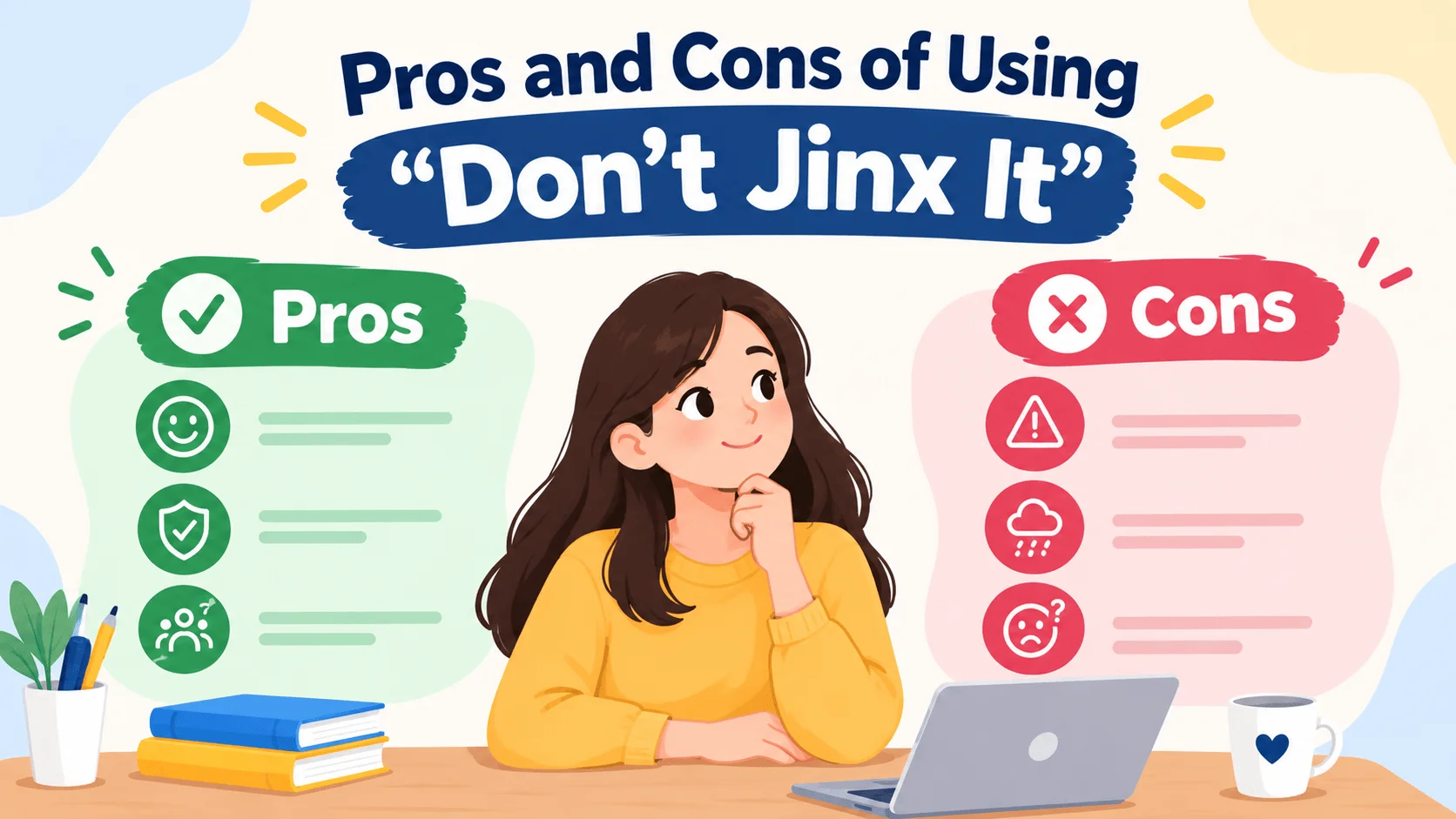
Advantages
Clarity: In informal conversation, the expression quickly communicates that an outcome is not guaranteed.
Efficiency: Three words can express caution, optimism, humor, and uncertainty at the same time.
Accessibility: It is a widely recognized idiom among many English speakers, especially in conversational American English.
Social connection: Its playful quality can make a conversation feel relaxed and familiar.
Emotional balance: It allows speakers to acknowledge good news without sounding excessively confident.
Potential Drawbacks
Oversimplification: It can reduce a complicated situation to the idea of “bad luck.”
Tone mismatch: It may sound inappropriate in formal or highly professional communication.
Repetition: Using the phrase too frequently can make writing or conversation feel predictable.
Cultural uncertainty: Not every international audience will understand the expression immediately.
Ambiguity: The listener may not know whether the speaker is joking, genuinely superstitious, or simply being cautious.
Real-Life Examples of Don’t tempt fate by Context
Emails
In a friendly internal email:
“The client has approved almost everything, and we’re just waiting on the final sign-off. Don’t jinx it, but I think we’re nearly there.”
For a formal client email, a more professional alternative would be:
“The project is progressing well, and we are now waiting for final approval.”
Meetings
A team leader might say:
“We’ve stayed under budget for the entire quarter.”
A coworker responds:
“Don’t jinx it; we still have two weeks to go.”
This sounds natural in an informal workplace conversation.
Presentations
The expression can work in a relaxed presentation:
“Our early customer feedback has been excellent. I don’t want to jinx it, but we’re off to a very strong start.”
For a formal presentation, “The early results are encouraging, although the outcome remains uncertain” would be more appropriate.
Conversations
“Looks like we might actually finish before midnight.”
“Don’t jinx it. We still have three chapters left.”
Social Media
“No traffic, no delays, and my flight is actually on time. Don’t jinx it! ”
Here, the phrase clearly functions as humor.
“Don’t Jinx It” vs Similar Expressions: Key Difference
Meaning Differences
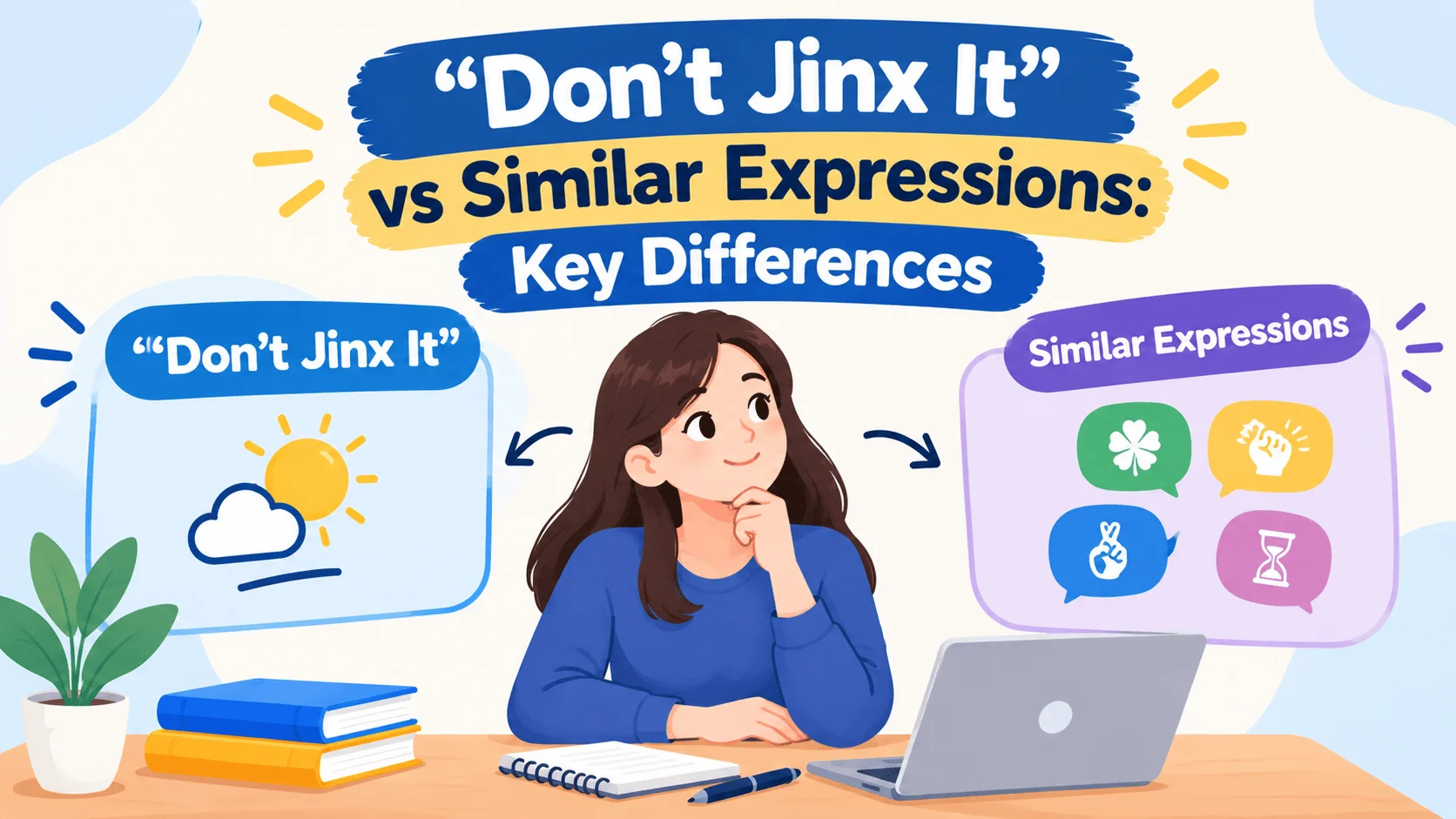
The central idea behind Don’t tempt fate is the fear or joking suggestion that confidently mentioning success might somehow interfere with it.
“Let’s not get ahead of ourselves” is more practical. It does not suggest bad luck; it simply advises people not to assume an outcome prematurely.
“Let’s wait and see” is even more neutral. It focuses on uncertainty rather than luck.
“Don’t tempt fate” is closer to “Don’t tempt fate,” but usually carries a stronger warning about risky behavior.
“Don’t count your chickens before they hatch” emphasizes premature expectations rather than supernatural bad luck.
“Keep your fingers crossed” has almost the opposite emotional direction. Instead of warning against optimistic talk, it expresses hope for a positive result.
Common Mistakes & Misuse of “Don’t Jinx It”
Overuse
Using “Don’t jinx it” after every positive statement can weaken its effect. If every successful event receives the same response, the expression can become repetitive.
Incorrect Context
Using it in a formal report or academic essay can make the writing sound conversational when a precise statement about uncertainty would be better.
Contradictory Usage
The phrase generally responds to a positive expectation that remains uncertain. Using it after an outcome has already been confirmed can sound strange.
For example, saying:
“We won the contract. Don’t jinx it.”
is less logical than saying it before the contract is officially awarded.
Cultural Misunderstandings
Some people may interpret “jinx” literally. Others may not recognize it at all. When communicating across cultures, use a clearer expression if there is any doubt.
Psychological Reason: People prefer not to tempt fate
Cognitive Load Reduction
Short idioms allow speakers to communicate a larger idea without explaining every detail. Don’t tempt fate quickly packages uncertainty, caution, and optimism into a familiar expression.
Trust and Authority Signals
In informal groups, shared idioms can signal familiarity. Someone who says “Don’t jinx it” is often showing that they understand the social mood of the conversation.
Attention Economy
Modern communication rewards short, recognizable expressions. A three-word phrase is easier to use in a text, Slack message, comment, or social media post than a lengthy explanation.
Modern Communication Habits
Digital communication has made conversational language increasingly visible in writing. Expressions once mainly associated with speech now appear regularly in messages, captions, workplace chats, and informal emails.
Still, efficient communication is not always the same as professional communication. The shortest phrase is not necessarily the best phrase for every audience.
US vs UK Usage of Don’t tempt fate.
Don’t tempt fate is well understood in both American and British English, although the broader cultural context and preferred alternatives can vary.
US Usage
In American English, “jinx” is especially familiar in casual speech, sports, entertainment, and everyday conversation. American speakers frequently use it humorously when something appears to be going well.
UK Usage
British English speakers also understand and use “jinx,” particularly in informal conversation. However, alternatives such as “Don’t tempt fate” and “Let’s not count our chickens” can also be natural depending on the situation.
Tone Perception
In both varieties, the phrase is generally informal rather than professional. Neither American nor British English treats it as an appropriate substitute for precise language in formal documents.
The difference is therefore less about correctness and more about frequency, cultural preference, and conversational style.
Don’t tempt fate in Digital & Modern Communication
Emails
In informal internal emails, the phrase can create warmth:
“The launch is looking really good so far. Don’t jinx it, but I think we’re ready.”
In formal emails, replace it with direct language about uncertainty.
Slack / WhatsApp
The phrase is highly natural in chat:
“The server has been stable all morning.”
“Don’t jinx it ”
Emoji and informal punctuation can reinforce its playful meaning.
Social Media
People commonly use the phrase when discussing travel, weather, sports, work achievements, relationships, or other uncertain events.
“Three green lights in a row on my commute. Don’t jinx it.”
AI-Generated Summaries
AI-generated writing may replace idiomatic language with more explicit wording depending on the context. For example:
“The team is optimistic, but the outcome has not yet been confirmed.”
This communicates the practical meaning of “Don’t tempt fate” more directly and is often preferable in summaries, reports, and professional content.
Linguistic & Communication Insight
Emotional Weight & Subtext
The literal meaning of “jinx” relates to bad luck, but native speakers often understand the phrase beyond that literal meaning.
When someone says Don’t tempt fate the listener may hear:
“I’m excited too, but let’s not assume we’re guaranteed to succeed.”
That is why the expression can sound playful rather than genuinely superstitious.
Direct vs Indirect Phrasing
“Don’t jinx it” is indirect because it does not explicitly say:
“The outcome remains uncertain.”
Instead, it uses a culturally familiar idea about bad luck to communicate caution.
A direct alternative such as “The outcome isn’t guaranteed yet” removes the humor but increases precision.
Professional Communication Perspective
At work, context matters more than the phrase itself.
With close colleagues, “Don’t jinx it” can make conversation feel natural and human. With clients, executives, regulators, or unfamiliar international audiences, the same wording may sound too casual.
An experienced communicator therefore considers relationship, channel, audience, and consequences before choosing the expression.
Pragmatic Reasons for Alternatives
Professionals often choose alternatives because they want to separate optimism from superstition.
Instead of:
“Don’t jinx it.”
they may say:
“Let’s wait for the final confirmation.”
This wording communicates caution while keeping the focus on evidence and process.
Likewise, “Let’s not get ahead of ourselves” can encourage realistic expectations without sounding negative.
Social Signaling
Word choice affects how people perceive confidence and cooperation.
“Don’t jinx it” can signal:
- Familiarity
- Humor
- Shared cultural knowledge
- Cautious optimism
“Let’s wait and see” can signal:
- Patience
- Neutrality
- Objectivity
“Let’s not get ahead of ourselves” can signal:
- Professional judgment
- Realism
- Controlled optimism
Tone & Context Guidance
Use “Don’t jinx it” when you want friendly caution.
Use “Let’s wait and see” when you want neutral uncertainty.
Use “Let’s not get ahead of ourselves” when you want professional restraint.
Use “Keep your fingers crossed” when you want to emphasize hope.
Use “Don’t tempt fate” when the situation involves an element of risk.
The strongest communicator is not someone who always chooses formal language. It is someone who matches the language to the audience and purpose.
Meaning, Usage & Examples for Each Alternative
Let’s Not Get Ahead of Ourselves
Meaning: This phrase means that people should not assume success or make conclusions before all the relevant facts or results are available.
Why This Phrase Works: It communicates the practical idea behind Don’t tempt fate without referring to luck or superstition. It is especially useful when you want to sound measured and realistic.
Real-World Usage Insight: This is one of the strongest workplace alternatives because it sounds natural without being excessively formal.
Best Use: Meetings, projects, business discussions, negotiations, planning, and professional emails.
Avoid When: You deliberately want a playful or humorous expression.
Tone: Neutral, professional, cautious.
US vs UK Usage: Common and natural in both American and British English.
Example (Meeting): “The client seems ready to sign, but let’s not get ahead of ourselves until we have the contract in writing.”
Let’s Wait and See
Meaning: This phrase means that the speaker prefers to wait for more information or for an event to happen before making a judgment.
Why This Phrase Works: It removes the superstition from Don’t tempt fate and focuses directly on uncertainty.
Real-World Usage Insight: It is particularly useful when nobody can confidently predict what will happen next.
Best Use: Meetings, conversations, decisions, predictions, and professional communication.
Avoid When: You need to express strong enthusiasm or urgency.
Tone: Calm, neutral, measured.
US vs UK Usage: Very common in both varieties of English.
Example (Email): “The initial response has been encouraging, but let’s wait and see what the full customer survey shows.”
Conclusion
Don’t tempt fate is a familiar English expression that combines optimism with caution. People typically use it when something is going well, but the final result is still uncertain. Although the phrase refers to the idea of bringing bad luck by speaking too confidently, modern speakers often use it humorously rather than literally.
The expression is most natural in casual conversations, friendly workplace chats, sports discussions, text messages, and social media. In formal emails, academic writing, legal communication, or professional reports, clearer alternatives such as “Let’s wait and see,” “Let’s not get ahead of ourselves,” or “Let’s wait until it’s confirmed” are usually more appropriate.
Understanding the difference between these alternatives helps you communicate with greater accuracy and confidence. The best expression depends on your audience, purpose, and desired tone. Whether you want to sound playful, supportive, cautious, or professional, choosing the right alternative ensures your message feels natural while preserving the intended meaning.
FAQs
What does Don’t tempt fate mean?
Don’t tempt fate means not to speak too confidently about a positive situation because doing so is traditionally believed to risk causing something to go wrong. In modern English, it is usually used humorously or casually to express caution when an outcome has not yet been confirmed or guaranteed.
Is Don’t tempt fate a synonym for “Don’t tempt fate”?
The two expressions are closely related but not identical. “Don’t tempt fate usually refers to talking about a positive outcome too confidently, while “Don’t tempt fate” can also warn against risky behavior or acting as though nothing can go wrong. Both expressions are informal and commonly used in casual English.
Is Don’t tempt fate professional?
Don’t tempt fate is generally considered casual rather than professional. It can work in relaxed conversations with familiar coworkers, but it may sound too informal in formal emails, reports, presentations, or client communication. Professional alternatives include “Let’s wait and see,” “Let’s not assume anything yet,” and “Let’s wait until it’s confirmed.”
Is Don’t tempt fate rude?
No, Don’t tempt fate is not normally rude. It is usually playful and friendly, especially when someone makes an optimistic prediction. However, tone and context matter. If someone is discussing a serious or sensitive issue, the phrase could appear dismissive or inappropriate, so a more direct and respectful expression may be better.
What is a professional alternative to Don’t tempt fate?
A strong professional alternative is “Let’s not get ahead of ourselves.” It communicates that a positive outcome should not be assumed before everything is finalized. Other suitable choices include “Let’s wait and see,” “Let’s not assume anything yet,” and “Let’s wait until it’s confirmed,” depending on the situation.
Can I use Don’t tempt fate in an email?
Yes, but it depends on the recipient and relationship. It can sound natural in an informal email to a familiar coworker, especially when the subject is positive and conversational. For clients, executives, or formal correspondence, a clearer phrase such as “The outcome is encouraging, but we should wait for confirmation” is more appropriate.
What is another way to say Don’t tempt fate?
Common alternatives include “Don’t tempt fate,” “Let’s not get ahead of ourselves,” “Let’s wait and see,” “Keep your fingers crossed,” and “Let’s not assume anything yet.” The best choice depends on your intended meaning. Some alternatives emphasize caution, while others focus more on hope, uncertainty, or avoiding premature expectations.
Why do people say “Don’t jinx it”?
People say Don’t jinx it” because they want to avoid treating an uncertain positive outcome as guaranteed. The expression comes from the traditional idea that mentioning good fortune too confidently might bring bad luck. Today, however, many people use it simply as a humorous way to express cautious optimism.
Is Don’t tempt fate more common in American or British English?
Don’t tempt fate is understood and used in both American and British English. It is especially natural in informal speech and writing. American English has strong everyday and sports-related use of “jinx,” while British speakers may also use alternatives such as “Don’t tempt fate.” Neither variety treats the phrase as formal language.
What is the difference between Don’t tempt fate and “Let’s not get ahead of ourselves”?
Don’t tempt fate suggests that talking too confidently about success could bring bad luck, often humorously. “Let’s not get ahead of ourselves” has a more practical meaning: do not assume success before the situation is finalized. The first is casual and idiomatic, while the second is more suitable for professional communication.